ONE:The number of places in which the inquiries under the commission were carried on was 237, having a population of 2,028,513. In twenty-five places the number of corporators was not ascertained; in the others (212) they amounted to 88,509. The governing body was self-elected in 186 boroughs. This body elected the mayor in 131 boroughs, appointed the recorder in 136, and the town-clerk in 135. The number of corporators exercising magisterial functions was 1,086, in 188 boroughs. In 112 boroughs the corporations had exclusive criminal jurisdiction, extending to the trial of various descriptions of offences, and in forty-two their jurisdiction was not exclusive. Seventeen boroughs did not enjoy any income whatever; in eight the precise amount could not be obtained. The total income of 212 boroughs amounted to ¡ê366,948; their expenditure to ¡ê377,027. 103 were involved in debts amounting to ¡ê1,855,371, and were besides burdened with annuities amounting to ¡ê4,463. In twenty-eight boroughs only were the accounts published; in fifteen the annual income was under ¡ê20; in eleven it was between ¡ê2,000 and ¡ê3,000; in five, ¡ê3,000, and under ¡ê4,000; in one, ¡ê4,000, and under ¡ê5,000; in four, ¡ê5,000, and under ¡ê7,500; in five, ¡ê10,000, and under ¡ê12,500; in one, ¡ê12,500, and under ¡ê15,000; in one, ¡ê15,000, and under ¡ê20,000; and in one, ¡ê91,000.The British losses in the battle of Moodkee were very heavy¡ª215 killed; among whom were Sir Robert Sale, Sir John M'Caskill, and a number of young officers who had greatly distinguished themselves. The wounded amounted to 657. Meanwhile, the enemy, having left seventeen guns upon the field, retired in tolerably good order, within their entrenched camp, which they had formed at Ferozeshah, on the banks of the Sutlej, near Ferozepore. For two days both armies remained inactive, but ready to renew the conflict. The losses of the British had been made up by the arrival of the 29th Queen's and the 1st Bengal Light Infantry. A memorable event in the history of British warfare in India, was that Sir Henry Hardinge, the veteran commander, the hero of so many battles, the Governor-General of India, offered his services to Sir Hugh Gough as second in command. The offer was accepted, and the army marched forth to attack the enemy's camp. They started at daybreak on the 21st, and about midday a junction[598] was effected with General Littler's division, which had marched out from Ferozepore, according to orders sent the night before. The British army was now raised to 19,000 effective men. The enemy were double that number, strongly entrenched, well provisioned, and fresh after two days' rest; while our troops were ill provided with food, and had marched ten miles that morning. To attack the Sikhs without waiting for some expected reinforcements was hazardous; to postpone the attack for another day seemed still more so¡ªas there was a second Sikh army of equal force, which would then have reached the scene of action. An immediate attack was therefore determined upon¡ªGough leading the right wing, and Hardinge the left. The Sikh artillery was heavier than the British. The guns were protected behind embrasures, the gunners were sure in their aim; and so terrible was the effect that the 62nd Regiment, which led on the attack, was nearly cut away, and several Sepoy regiments broke and fled. The whole of the left wing, though led on gallantly by the Governor-General, were driven back, after carrying part of the works. The right wing, under General Gough, succeeded better, and held possession of several of the ramparts. But the Sikhs were still in possession of the fortified village of Ferozeshah, and remained so till night closed upon the scene; when the smoke and dust subsided, and the silence was broken only by an occasional shot from the guns, responded to in the darkness¡ªthe gunners seeing no enemy, but aiming at the flash of light.
ONE:But Nelson had now tracked the French to their goal, and was preparing to annihilate their fleet. Admiral Brueys, unable to enter the harbour of Alexandria, had anchored his ships in the Bay of Aboukir, in a semicircular form, so close in shore that he deemed it impossible for ships of war to thrust themselves between him and the land. He had altogether thirteen ships of war, including his own flagship of one hundred and twenty guns, three of eighty, and nine of seventy-four, flanked by four frigates and a number of gunboats, with a battery of guns and mortars on an island in the van. Nelson had also thirteen men-of-war and one five-gun ship, but the French exceeded his by about forty-six guns, three thousand pounds' weight of metal, considerably more tonnage, and nearly five thousand men. No sooner did Nelson observe the position of the French fleet than he determined to push his ships between it and the shore. No sooner was this plan settled than Nelson ordered dinner to be served, and on rising from table said, "Before this time to-morrow I shall have gained a peerage, or Westminster Abbey." It was half-past five o'clock on the afternoon of the 1st of August, 1798, when this celebrated battle was commenced. As the British vessels rounded a shoal, to take up their position, the battery of the island played upon them; but this ceased as they came near the French line of vessels, lest they should damage their own countrymen. Unfortunately, Nelson lost the use of the Culloden, a seventy-four, commanded by Captain Trowbridge, which struck on a ledge of rocks, and could not be got off in time for the engagement. Nelson's own vessel was the first that anchored within half pistol-shot of the Spartiate, the third ship of the French line. The conflict immediately became murderous, and Nelson received a severe wound on the head, which compelled him to go below. The battle continued with a terrible fury till it was so dark that the only light the combatants had to direct their operations was the flashes of their own broadsides. At ten o'clock the Orient, Admiral Brueys' own great ship, was discovered to be on fire. He himself had fallen, killed by a cannon-shot. The stupendous ship continued to burn furiously, lighting up the whole scene of action. At eleven it blew up, with an explosion which shook the contending fleets like the shock of an earthquake, and with a stunning noise that caused the conflict instantly to cease. A profound silence and a pitchy darkness succeeded for about ten minutes. Nelson, wounded as he was, had rushed upon deck before the explosion, to order every possible succour to be given to the shrieking sufferers in the burning ship, and many of the crew had been got into boats and saved. The cannonade was slowly resumed, but when morning dawned two French ships and two frigates only had their colours flying and were able to get away, none[468] of the British vessels except the Zealous being in a condition to give chase. The two ships of the line and one of the frigates were afterwards intercepted by our Mediterranean fleet, so that of all this fine fleet only one frigate escaped. Had Nelson not been wounded, and had Captain Trowbridge been able to bring up his ship, probably not even that frigate would have got away. The British took eight vessels of the line; the rest were destroyed in one way or other. The loss of the British, in killed and wounded, was eight hundred and ninety-five; of the French, in killed, wounded, and prisoners, was nine thousand eight hundred and thirty. Brave Brueys, as has been stated already, was slain. Captain Westcott, of the Majestic, was the only commander of a ship who fell. Such was the victory of Aboukir; but "victory," said Nelson, "is not a name strong enough for such a scene¡ªit is a conquest!" Fortunately for the French, Admiral Brueys had secured the transports and store-ships in shallow water in the port of Alexandria, where Nelson could not come at them for want of small craft. Half-a-dozen bomb ships would have destroyed them all, and have left Buonaparte totally dependent on the Egyptians for supplies. And these he must have collected by force, for now the news of the destruction of his fleet was spread over all Egypt by bonfires, kindled by the Arabs, along the coast and far inland. He was cut off from communication with France. On the 22nd of October the people of Cairo rose on the French, and endeavoured to massacre them; but the French took a bloody vengeance, sweeping them down with grape-shot, pursuing them into their very mosques, and slaughtering in one day five thousand of them.
TWO:CHAPTER II. THE REIGN OF GEORGE III. (continued).At the Church of St. Anne, Shandon, under a kind of shed attached to a guard-house, lay huddled up in their filthy fetid rags about forty human creatures¡ªmen, women, children, and infants of the tenderest age¡ªstarving and fever-stricken, most of them in a dying state, some dead, and all gaunt, yellow, hideous from the combined effects of famine and disease. Under this open shed they had remained during the night, and until that hour¡ªabout ten in the morning¡ªwhen the funeral procession was passing by, and their indescribable misery was beheld by the leading citizens of Cork, including the mayor, and several members of the board of guardians. The odour which proceeded from that huddled-up heap of human beings was of itself enough to generate a plague.
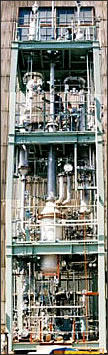
High quality is being demanded in many fields nowadays and so in order to satisfy that we developed a high-purity distillation system in collaboration with Ube industries, Ltd. and Kanto Chemical Co., Inc. The system is used to refine cleaning solutions for the semiconductor industry, medical materials, etc. of high purity (residual ion concentration: 0.01 to 1.0 ppb).
THREE:
Our High-purity distillation system provide our clients with high solvent recovery rate, almost 100%.
The quality of the products/output from our system is very stable, which makes production management very easy, and easier than the conventional ion exchange resin method.
No emission of waste brings our clients reduction of running cost for environmental measures.
Our various devices minimize entrainment.
To prevent the elution of metal, you could ask us the system made of Teflon.
Our High-purity distillation system has been already proved for solvents that trigger very rapid decomposition reactions, such as hydrogen peroxide.